
Stop Calling It "Worship Leading" If You're Just Running a Concert
— Here's the Difference
By Worship Template Now | Worship Leadership | Worship Planning Tips
Let's get uncomfortable for a second.
Walk into most evangelical churches on a Sunday morning and you'll find something that looks incredible on the surface — lights, great sound, talented musicians, and a worship leader who could headline a Christian music festival.
But ask the 60-year-old woman in the third row if she felt like she encountered God today, and she might pause before answering.
That pause? That's the gap between worship performance and authentic worship leadership. And it's wider than most of us want to admit.
Whether you're brand new to leading worship or you've been doing this for a decade, this post is your no-fluff playbook for crossing that gap.
We're talking about what the Bible actually says, what reformed theologians have argued for centuries, and what your congregation genuinely needs from you every Sunday morning.
First, Let's Kill a Myth: "Performance" Isn't a Dirty Word
Here's something that might surprise you. The word perform originally meant "to carry out what is required." That's it. And Psalm 33:3 literally commands us to "play skillfully."
So the moment you pick up an instrument, open your mouth, or step behind a microphone — you are performing. That's not a sin. That's obedience.
The problem has never been performance. It's always been posture.
The reformers understood this deeply. John Calvin argued that worship must be ordered, intentional, and theologically rich — not spontaneous emotionalism.
The Westminster Confession of Faith, one of the foundational documents of evangelical reformed theology, holds that acceptable worship to God must be regulated by Scripture — not by what feels organic in the moment.
The philosopher Søren Kierkegaard (though not Reformed himself) gave us a picture that every worship leader needs to internalize: In corporate worship, the congregation are the actors. God is the audience. The worship leader is just the prompter.
Your job isn't to have the best moment up front. Your job is to cue the congregation to direct their praise toward God.
When you see it that way, everything changes.
"Ascribe to the LORD the glory due his name; worship the LORD in the splendor of holiness." — Psalm 29:2 (ESV)
Are You a Song Leader or a Worship Leader?
(There's a Real Difference)
This is a question worth sitting with honestly.
A song leader shows up, picks songs they like, hits the notes, and hopes people sing along. The music gets executed. Check.
A worship leader shows up having already been with God that week — and their job Sunday morning is to take the congregation somewhere. Not just through a setlist, but into the presence of God. The music is the vehicle, not the destination.
John Piper put it plainly: "Worship is a way of gladly reflecting back to God the radiance of His worth." That reflection has to come from somewhere real in you before it can invite something real in your congregation.
Here's a practical way to know which one you are right now:
Do you rehearse until the music becomes second nature — so your mind and heart are free on Sunday morning?
Do you worship privately at home when nobody's watching?
Are you intentionally guiding your congregation through emotional and theological stages — or just executing a setlist?
If you want templated setlist structures built around intentional worship journeys, Worship Template Now has ready-to-use planning tools right here.
The Concert Culture Problem Nobody Wants to Talk About
Here's where it gets a little spicy.
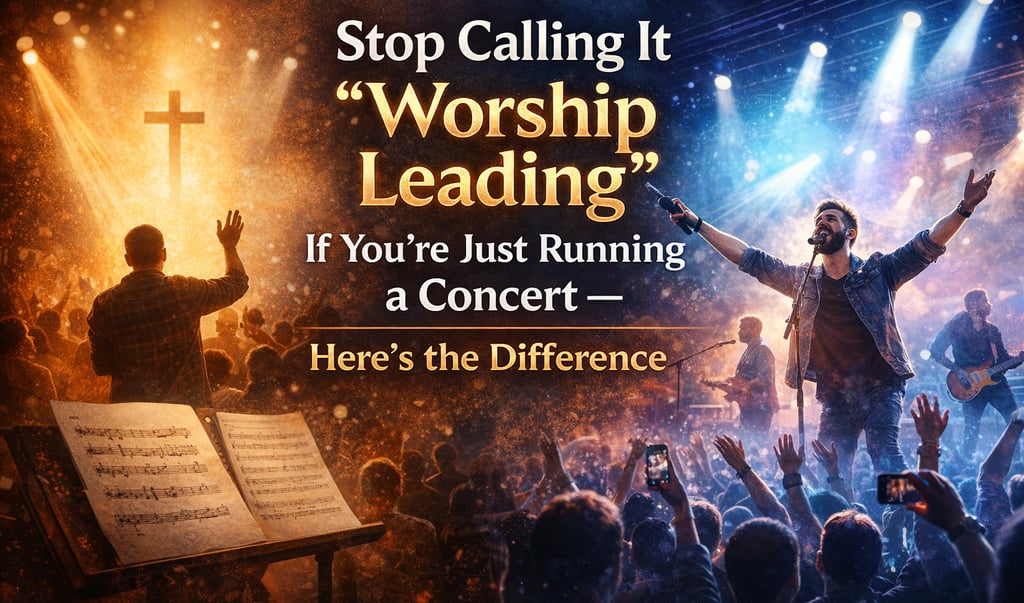
The last 20 years of evangelical worship culture have been quietly shaped by a concert model — heavy amplification, dim lighting with stage lighting, and worship leaders who move and perform like Christian pop artists.
And look, there's nothing inherently evil about any of those things. But they've had a side effect that should concern every pastor and worship leader:
They've turned congregations into audiences.
R.C. Sproul wrote in A Taste of Heaven that Christian worship has historically been understood as the most important activity of the church — a covenantal gathering where God speaks and His people respond. It is participatory by nature. It is not a spectator sport.
So ask yourself these three honest questions:
1. Can your congregation hear themselves sing? If your stage volume completely drowns out the voices in the pews, you've quietly converted corporate worship into a private listening experience.
Communal singing — the sound of the whole congregation lifting their voices together — is not a nice bonus. It's integral to biblical worship. Acts 4:24 says they "raised their voices together" — together being the operative word.
2. Can the average person in your church actually sing your songs? Vocal runs, spontaneous key changes, unpredictable rhythmic shifts — these are great at a concert.
In a congregation of nurses, teachers, plumbers, and accountants on a Sunday morning, they're congregation killers. Your virtuosity can directly produce their passivity. That's on you.
3. Is your band the center of attention? This one stings. But it's worth asking. If the joy in the room is coming primarily from watching talented people do impressive things — rather than from a genuine love for Jesus — you have a priorities problem.
As Ligon Duncan and others in the reformed tradition have argued, the gathering exists to glorify God, not to platform musicians.
The 4 Pillars of Authentic Worship Leadership
Alright, enough diagnosis. Let's talk about what to actually build your ministry on.
1. Embrace Your Role as a Pastoral Theologian
Whether you realized it when you accepted the position or not — if you're choosing the songs your church sings, you are teaching theology. Every week. To every person in those seats.
The songs you pick introduce your congregation to the character of God. Names, metaphors, attributes — they're all in there. Which means your theology has to be sharp.
A helpful grid from the reformed tradition: Is the song Trinitarian? Does it accurately reflect the God of Scripture — not just a feeling or an experience, but the holy, just, gracious God revealed in the Old and New Testament?
B.B. Warfield's emphasis on the centrality of Scripture applies directly here. If the lyrics can't hold up to biblical scrutiny, they probably shouldn't be in your setlist.
As theologian Robert E. Webber put it: "Worship without theology is sentimental and weak; theology without worship is cold and dead."
Need help evaluating song lyrics for theological depth? Download our worship planning worksheets at Worship Template Now.
2. Balance Vertical and Horizontal Worship — and Know the Difference
Every corporate worship song broadly does one of two things:
Vertical worship is directed to God — speaking to Him about His character, power, and presence. Think "Holy, Holy, Holy" or "How Great Thou Art." These songs help the congregation disappear into God's greatness.
Horizontal worship tells our story about God — testimonies, encouragement, communal declarations. These songs have real value, but they're secondary in a corporate gathering.
Reformed worship theology has long prioritized the Regulative Principle — that our worship should be shaped by what Scripture commands.
And Scripture is overwhelmingly vertical in its worship language. The Psalms, our biblical songbook, are addressed to God. They cry out to Him, praise Him, lament to Him.
A good rule of thumb: Your set should lean at least 60-70% vertical. People didn't drive to church to sing about their own experiences. They came to meet with the living God.
3. Transition from "Lead Worshiper" to "Servant Leader"
There was a season — probably the late 2000s through early 2010s — where the dominant model was the "lead worshiper." The idea was: just close your eyes, get lost in the Spirit, and lead from your own encounter.
The problem is practical and theological.
Practically: if your eyes are closed for most of the service, you've cut off half your feedback from the congregation. You're no longer leading — you're just having a personal worship experience with a microphone.
Theologically: the reformers drew a sharp line between private devotion and public worship. Your private worship time is between you and God.
Sunday morning is for the congregation. You are there to serve them. As the Westminster Larger Catechism notes, public worship is a distinct act with its own ordinances, expectations, and responsibilities.
Think of yourself as a dinner party host. A good host doesn't sit down, eat their own meal, and ignore the guests. They make sure everyone else is fed. Find your personal worship time during the week — so you can pour out and facilitate on Sunday.
4. Build a Blended, Unified Worship Approach
The worship wars between traditional hymns and contemporary choruses have caused more church splits and ministry burnout than most people want to count. But the most effective worship leaders operating today have found a third way.
Blended worship — synthesizing historic hymns with contemporary expressions — isn't a compromise. It's actually the most theologically robust approach available to us.
When you sing "Before the Throne of God Above" in a modern arrangement alongside a contemporary chorus, you're connecting your congregation to the Communion of Saints — the great cloud of witnesses who have worshipped the same God across centuries. That's not nostalgia. That's theology lived out through song.
The gospel never changes. But the delivery system can — and should — remain culturally accessible to the people you're trying to reach.
The Comparison Game Will Quietly Destroy Your Ministry
One more thing nobody talks about enough.
With YouTube, Spotify, and social media, it is brutally easy to stack your 12-person volunteer team up against a professionally produced Bethel or Elevation worship service with a multi-million dollar budget and a full-time staff of musicians.
When you do that, one of two things happens: you become disenchanted with your own team, or you become prideful when you sound better than the church down the street.
Both of those outcomes destroy authentic worship leadership.
Here's the Reformed corrective: God is not impressed by production value. He is moved by the humble, obedient praise of His people. Psalm 22:3 tells us He inhabits the praises of Israel — not the praises of the most talented, but the praises of His people.
Your congregation of accountants and construction workers and stay-at-home moms lifting their voices together is beautiful to God. Not despite its imperfections, but within them.
Authentic worship is ordinary people ascribing glory to an extraordinary God. That's it. That's the assignment.
Your 7-Step Action Plan for Authentic Worship Leadership
Here's how to start applying all of this starting this week:
1. Protect your private spiritual life. You cannot lead people to a place you haven't been. Daily prayer and personal worship aren't optional for worship leaders — they're the source. Your Sunday leadership is an overflow of your private devotion. Guard it fiercely.
2. Apply the 60-70% Familiar Rule. The majority of your setlist should be songs your congregation already knows and loves. Introduce new songs slowly and intentionally. Comfortable keys (generally C to D range) keep the congregation singing instead of watching.
3. Design an intentional worship journey. Every set should have an arc. Start with upbeat, familiar songs for Gathering. Move into slower, more intimate songs for Encounter. Close with a powerful Sending moment. Don't just pick songs — design a journey. Use our Energy Arc setlist templates at Worship Template Now to build this out.
4. Master the music so you can forget it. Practice until the music is muscle memory. When you no longer have to think about chords and lyrics, your mind is free to worship authentically and stay attentive to the Holy Spirit and your congregation at the same time.
5. Nail your transitions. The moments between songs are where worship leaders lose congregations. Practice smooth key and tempo transitions. Keep spoken transitions brief, prayerful, and pointed toward God — not toward yourself or the band. Download our transition planning guides here.
6. Audit your lyrics for theological integrity. Run every song through a simple theological filter: Is it biblically accurate? Is it Trinitarian? Does it prioritize vertical expression? If a song is doctrinally shaky or vague, it doesn't belong in corporate worship — no matter how popular it is on Christian radio.
7. Turn it down and step back. Worship is not a concert. Lower the stage volume until your congregation can hear themselves singing. Reduce lighting that spotlights the band and darkens the congregation. Your role is to serve and guide — not to be seen. The moment the congregation forgets you're up there and focuses entirely on God, you've done your job.
The Bottom Line
Leading worship is one of the most beautiful privileges in the local church. It's also one of the most misunderstood.
You are not an entertainer. You are not a celebrity. You are not even, primarily, a musician. You are a servant, a theologian, a pastor — and your job every Sunday is to take posture of a humble heart of worship to help the people entrusted to your care and usher them to encounter the living God through song, Scripture, and Spirit-filled community.
Prepare diligently. Play skillfully. Keep your eyes open and love the people in front of you. Turn the volume down just enough to hear the church singing. And then point them — every time, without exception — to Jesus.
"Sing to him a new song; play skillfully, and shout for joy." — Psalm 33:3 (NIV)
Ready to plan worship with both theological depth and practical tools? Explore worship planning templates, setlist builders, and resources designed for real worship leaders at Worship Template Now.
Referenced & Recommended Resources
The Westminster Confession of Faith (1646) — CCEL.org
Westminster Larger Catechism — Westminster Standards
R.C. Sproul, A Taste of Heaven: Worship in the Light of Eternity — Reformation Trust, 2006
John Piper, Desiring God — desiringgod.org
Ligon Duncan, "Does God Care How We Worship?" — Ligonier Ministries
Robert E. Webber, Worship Old and New — Zondervan
B.B. Warfield on Scripture — The B.B. Warfield Page
Tags: how to lead worship, worship leader tips, authentic worship leading, worship planning for churches, blended worship approach, theology of worship, reformed worship theology, corporate worship planning, worship setlist planning, how to build a worship set, worship leader training, Planning Center alternatives, worship leader vs song leader, concert culture in church, congregational singing, vertical vs horizontal worship
Contact
Questions? Reach out anytime.
support@worshiptemplatenow.com
© 2026. All rights reserved by Worship Template Now.